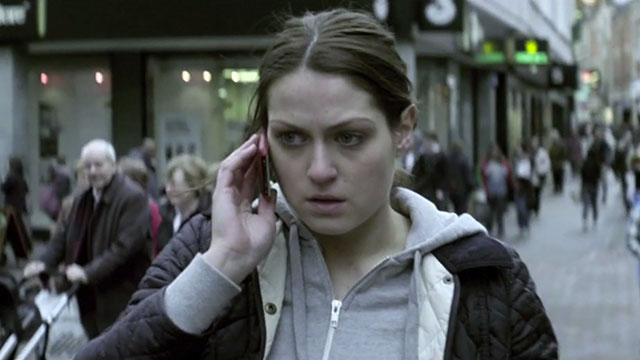
 Echo (2013) is a short film, directed by Lewis Arnold, about a teenage girl who is a con artist - we see her faking a phone call where she breaks down after supposedly receiving some tragic news.
I would describe Echo primarily as a character study about a teenage girl dealing with grief. In the NEA booklet, it is described at 'personal interest/true story', however I don't feel that this accurately describes the film, given that it is only very loosely based on a true story. The narrative of the film is based around three phone calls, beginning and ending with the first and last phone call, and shows some other aspects of the girl's personal life in between these calls. It could also be described as a circular narrative (depending on your interpretation of the ending), as there is a suggestion that the phone call which she has been faking has come true.
The micro-element of the film which is most striking from the very beginning is the use of colour saturation; the film has a very desaturated, muted colour palette, which creates a gloomy mood and reflects the main character's inner-psyche. Also, each phone call has a different style: the first phone call uses a long lens and has several long takes, giving the perspective of an observer. The final phone call, however, uses lots of quick cutting, handheld camera, jump cuts and slow motion, creating a more personal connection between the audience and the main character.
Personally, I have mixed feelings about Echo. I think that it has plenty of interesting ideas, but is confused about what the overall meaning and message of the film is. The ending, for example, would make sense if it was intended to be a flashback to when the main character received a real phone call delivering bad news, however the director said in an interview that it was, in fact, just another phone call. To me, this conflicts with the way the scene is directed, as the micro-elements suggest that the character is really panicking and experiencing a traumatic event, whereas the first scene uses a more understated style of camerawork that makes more sense in the context of the scene. There is also a scene near the end of the film where the main character's younger brother goes out cycling with a flat tyre, strongly implicating that he will get into an accident like her father did, however this doesn't ever happen.
However, there are elements of the film which I admire and which may influence my short film. I like the sense of ambiguity in the film and how the viewer is partly left to piece together information, along with the irresolute note which the film ends on. I also think that the main character is very interesting in that we are given very little explicit information about her character and are left to work out her motivations for ourselves. I may want to incorporate a sense of ambiguity in my film which leaves viewers thinking about the film and trying to work out its narrative and meaning.
Comments
Post a Comment